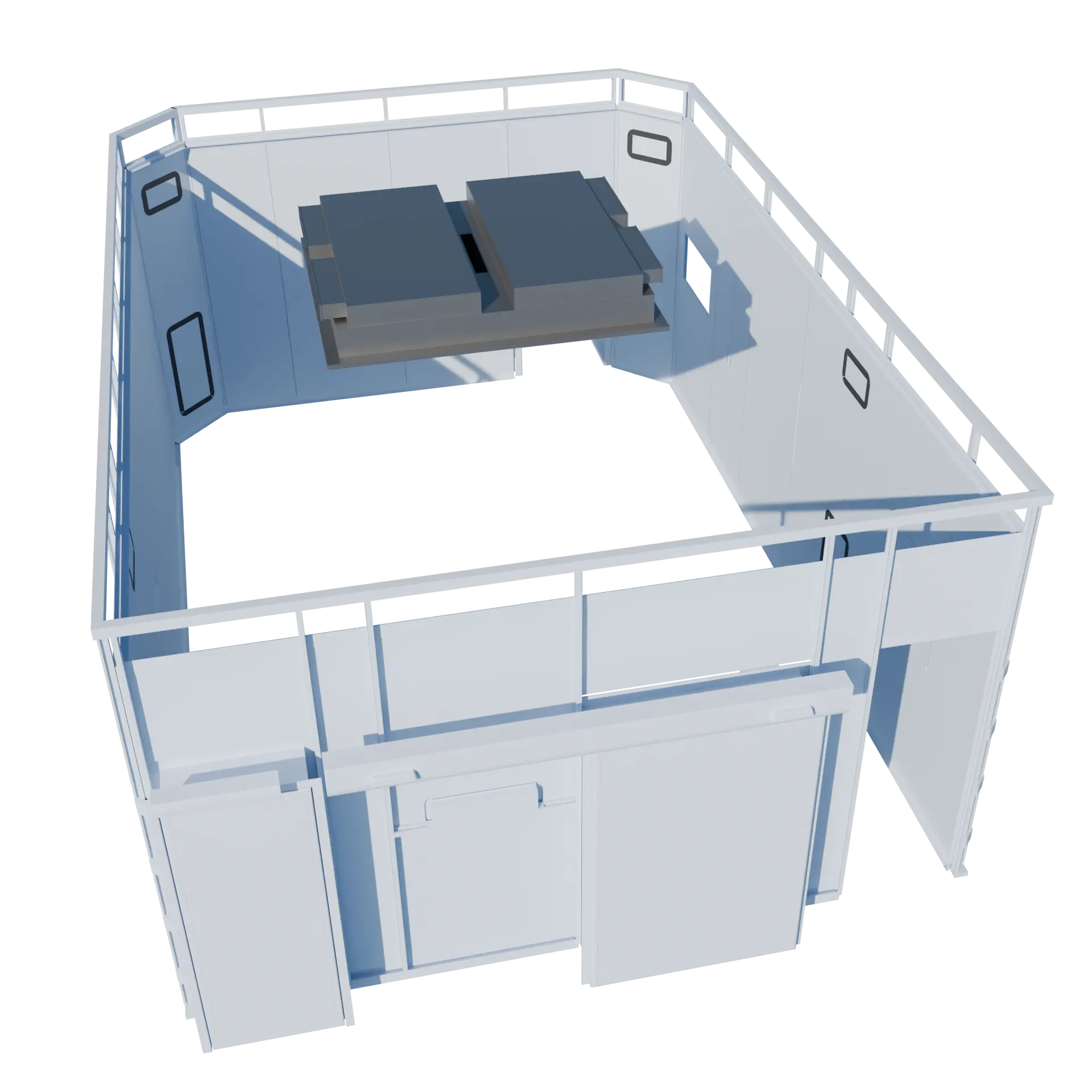
Room Ventilation and Air Distribution
Pressure-Driven HVAC Flow Analysis for Residential Buildings
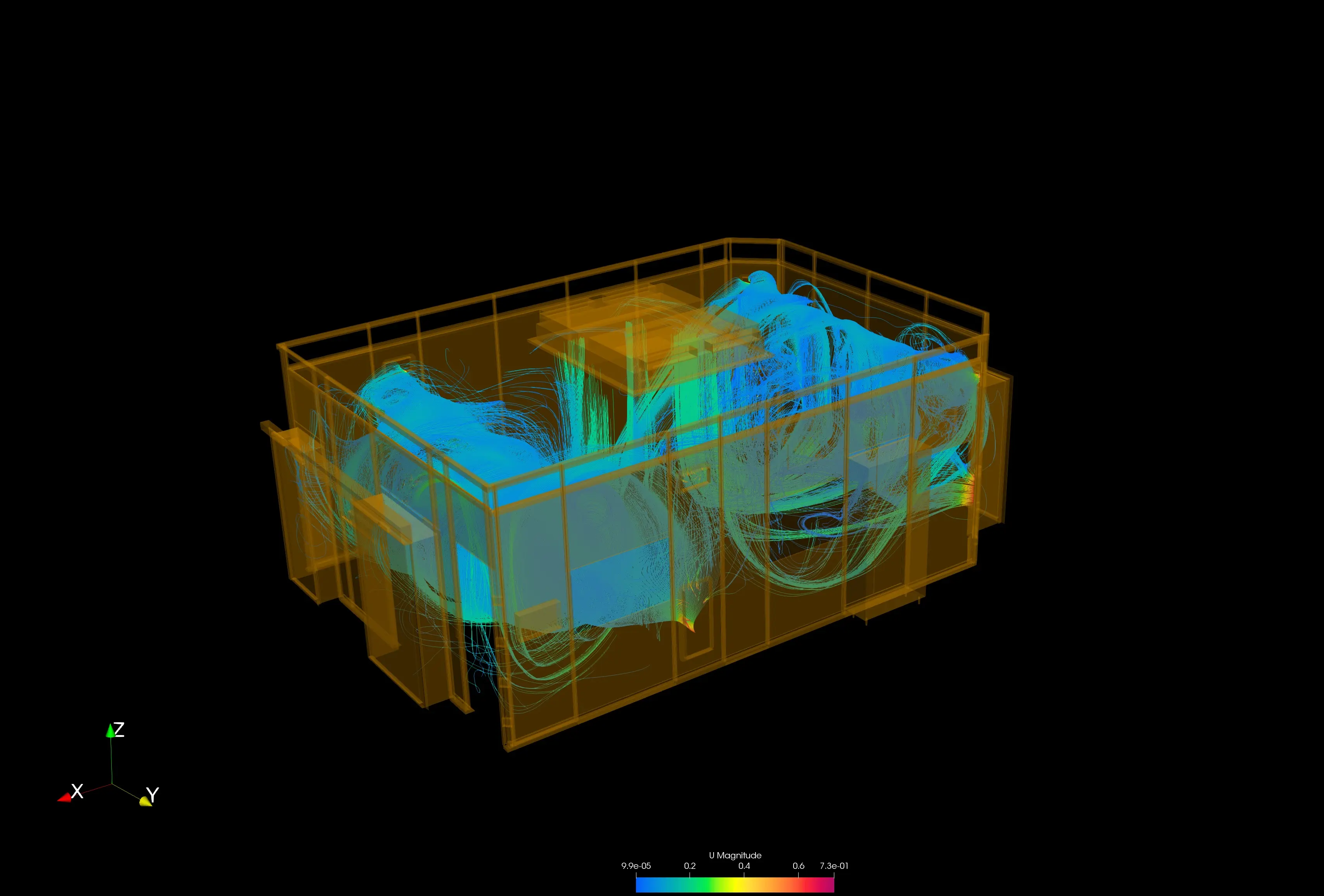
Velocity (m/s): 0 → 2.5
Velocity streamlines showing air circulation patterns and stagnant zones in residential room
Abstract
Comprehensive CFD analysis of pressure-driven airflow within a residential room to evaluate ventilation effectiveness and indoor air distribution. The simulation investigates how air supplied by the HVAC system circulates throughout the space, identifying regions of good mixing and potential stagnant zones.
This study provides critical insights for optimizing vent placement and flow rates to ensure adequate air circulation and indoor air quality in residential buildings. The pressure-driven approach accurately captures realistic operating conditions where supply and return vents create the driving force for air movement.
The CFD analysis successfully characterized pressure-driven airflow and air distribution, revealing both effective circulation zones and areas requiring design attention. The supply jet provided good momentum for air mixing in the main occupied zone, while corner regions and spaces behind furniture exhibited reduced air movement.
Metodologia
Numerical Approach
- ▸Steady-state RANS simulation with realizable k-epsilon turbulence model
- ▸Pressure-driven flow with fixed pressure boundaries at supply/return vents
- ▸Incompressible flow solver with SIMPLE algorithm
- ▸Second-order discretization schemes for improved accuracy
- ▸Buoyancy effects neglected (isothermal approximation)
- ▸Convergence criteria: residuals below 10⁻⁵
Computational Domain
- ▸Standard residential room: 4m × 3.5m × 2.8m
- ▸Supply vent on ceiling (0.3m × 0.3m) with fixed total pressure inlet
- ▸Return vent on opposite wall near floor (0.4m × 0.2m) at atmospheric pressure
- ▸No-slip walls with zero pressure gradient
- ▸Simplified furniture as solid obstacles
- ▸Mesh: 450k hexahedral elements with refinement near vents
- ▸Boundary layer resolution with y+ = 30-100
- ▸Flow rate: 150 m³/h typical HVAC capacity
Risultati e Scoperte
The CFD analysis characterized pressure-driven airflow revealing effective circulation zones and areas requiring design attention for optimal air distribution.
Key Findings
- 1High-velocity jet from ceiling impinges on floor before spreading laterally
- 2Velocity range from 0.05 m/s in corners to 2.5 m/s at supply jet core
- 3Stagnant zones (< 0.1 m/s) identified in corners behind furniture (12% of volume)
- 4Air change rate: 4.5 ACH meeting residential ventilation standards
- 5Ventilation effectiveness index: 0.78 indicating acceptable distribution
- 6Pressure drop between supply and return: 8 Pa
Ready to Optimize Your System?
Let's discuss how CFD analysis can deliver measurable performance improvements for your engineering challenge.
Start a Conversation