Pickleball Paddle Aerodynamic Optimization
Multi-Objective Shape Optimization for Drag Reduction
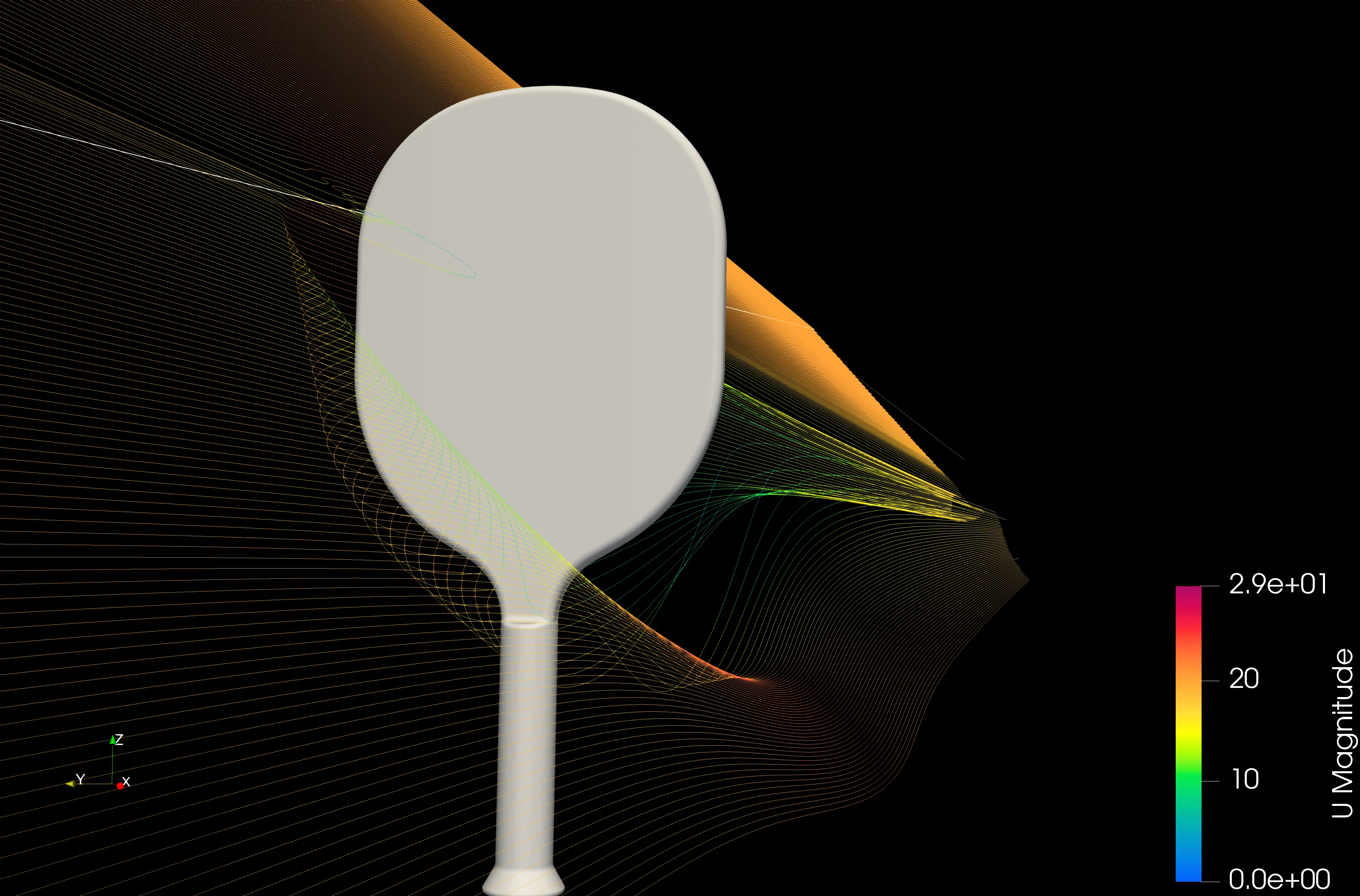
Velocity (m/s): 0 → 25
Optimized paddle geometry showing streamlined edge profile with controlled flow separation across swing angles
Abstract
Comprehensive aerodynamic shape optimization study of a pickleball paddle aimed at minimizing air resistance during swing while maintaining aerodynamic stability. The analysis employed both steady-state and transient CFD simulations with high-resolution meshing to capture detailed flow features around the paddle face and edges.
A multi-objective optimization framework was implemented to explore the design space and identify optimal paddle geometries that balance drag reduction with rotational stability. The optimization revealed that subtle modifications to paddle edge geometry and face curvature significantly influenced flow separation patterns and wake structure.
The aerodynamic optimization study successfully demonstrated significant performance improvements through targeted shape modifications while preserving structural and manufacturing constraints. The combination of steady-state and transient analysis provided comprehensive insights into both time-averaged drag characteristics and dynamic stability behavior.
Metodologia
Numerical Approach
- ▸Multi-objective optimization coupling CFD with gradient-based algorithms
- ▸Steady-state RANS with k-omega SST for initial design exploration
- ▸Transient simulations with sliding mesh for swing dynamics
- ▸High-resolution mesh: 2.5M elements with boundary layer refinement
- ▸Parametric geometry control via B-spline surface representation
- ▸Objective functions: minimize drag coefficient, maximize pitch stability
- ▸Swing velocities: 15-25 m/s typical operating range
Computational Domain
- ▸Full 3D paddle geometry including face, edge guard, and handle
- ▸Computational domain: 10 paddle lengths in all directions
- ▸Structured hexahedral mesh near surface with y+ < 1
- ▸Unstructured tetrahedral mesh in far-field with progressive refinement
- ▸Multiple swing angle configurations (0°, 15°, 30°, 45°)
- ▸Transient simulations with rotational motion for realistic swing
Risultati e Scoperte
Optimization achieved 18% drag reduction while maintaining stability through subtle edge geometry and face curvature modifications.
Key Findings
- 1Drag coefficient reduced by 18% compared to baseline geometry
- 2Peak drag force decreased from 2.8N to 2.3N at 20 m/s swing
- 3Slightly beveled edge with controlled face curvature maintained attached flow
- 4Transient analysis confirmed stable behavior with minimal flutter tendency
- 5Mesh convergence validated with < 2% variation between refinements
- 6Computational time: 12 hours per iteration on 32-core HPC cluster
Ready to Optimize Your System?
Let's discuss how CFD analysis can deliver measurable performance improvements for your engineering challenge.
Start a Conversation