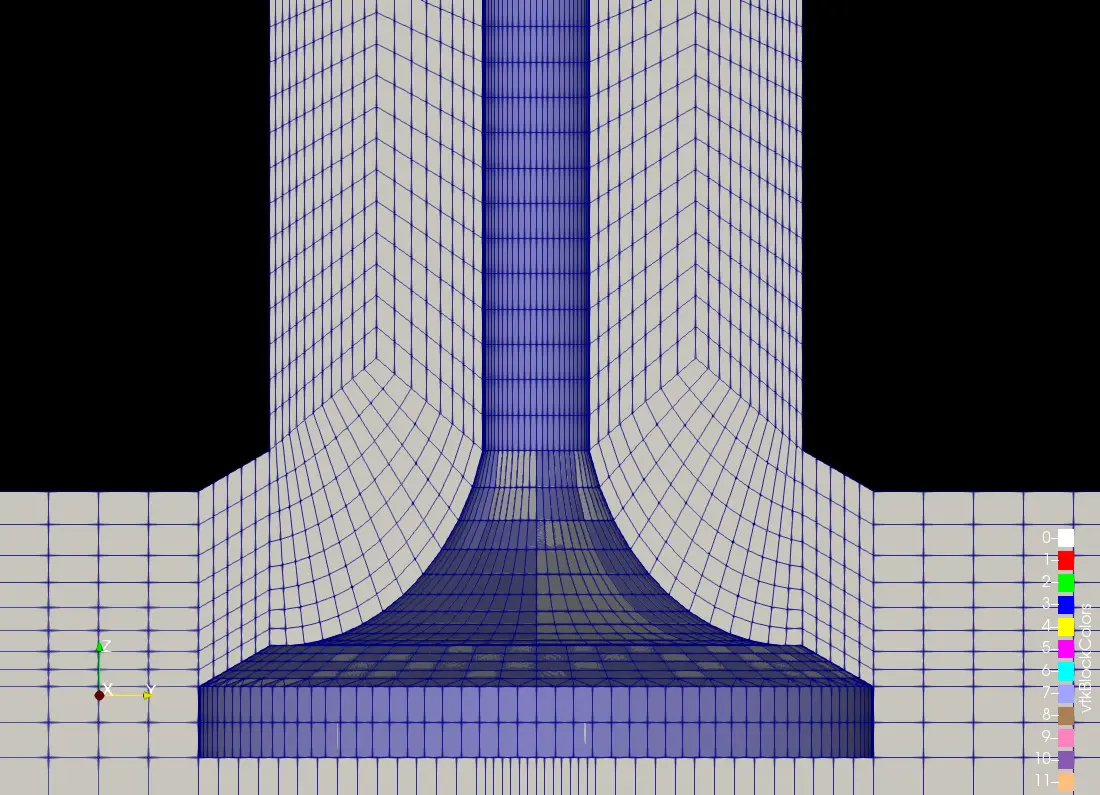
Marine Diesel Engine Cold Flow Analysis
Parametric Study with Moving Piston and Custom Solver
Species Concentration: 0 → 1
Species concentration fields showing charge stratification influenced by intake port geometry and wall interactions
Abstract
Comprehensive parametric study of cold flow dynamics in a marine diesel engine cylinder during the intake and compression strokes. The simulation employs a custom-developed coupled solver that integrates moving mesh capabilities with species transport and diffusion modeling to investigate in-cylinder flow patterns and their influence on charge mixing.
A key innovation of this work is the implementation of a graphical user interface (GUI) that enables real-time parametric modification of all piston geometry parameters, allowing for rapid exploration of design variations without mesh regeneration.
The parametric cold flow study successfully demonstrated the capabilities of the custom coupled solver in capturing the complex interaction between moving boundaries, turbulent flow, and species transport in marine diesel engines. The GUI-based parametric interface proved instrumental in efficiently exploring the design space.
Metodologia
Numerical Approach
- ▸Custom coupled solver based on OpenFOAM with enhanced species transport
- ▸Dynamic mesh motion using layering and sliding interface techniques
- ▸GUI-based parametric framework for real-time geometry modification
- ▸Finite volume discretization with second-order accuracy
- ▸Species transport with forced diffusion terms
- ▸Parametric variations: piston speed (50-150 RPM) and intake port geometry
Computational Domain
- ▸Full 3D cylinder geometry including piston crown and cylinder head
- ▸Moving mesh boundary at piston with automatic layer addition/removal
- ▸Refined mesh near walls and intake ports
- ▸Periodic boundary conditions for multi-cylinder effects
- ▸Initial conditions representing residual gas from previous cycle
Risultati e Scoperte
The custom coupled solver successfully captured complex tumble and swirl flow structures with parametric optimization revealing optimal operating conditions.
Key Findings
- 1Complex tumble and swirl structures vary significantly with piston position and RPM
- 2Species concentration showed distinct stratification patterns
- 3Tumble ratio varied between 1.2-1.8 depending on operating conditions
- 4Mixing efficiency improved by 15% with optimized intake geometry
- 5GUI interface enabled rapid evaluation of multiple piston configurations
- 6Custom solver demonstrated excellent stability with CFL < 0.7
Ready to Optimize Your System?
Let's discuss how CFD analysis can deliver measurable performance improvements for your engineering challenge.
Start a Conversation